

As elected councillors come to vote on Mike Lee’s Notice of Motion at the Policy and Planning Committee Meeting, they will be receiving advice from the Plans and Places team. We ask that the elected councillors read the following information, and use it as a lens when considering the planning and policy advice that they receive. Councillors, this is written for you.
Delay and Minimisation
Council’s Plans and Places team has been asked to make changes to the helipad provisions in the Hauraki Gulf Islands District Plan many times, but each time has elected not to. We’re aware of the following instances:
2017
The Waiheke Local Board raised the issue of increasing helicopter flights and consents and Plans and Places came back with a report with the following options:
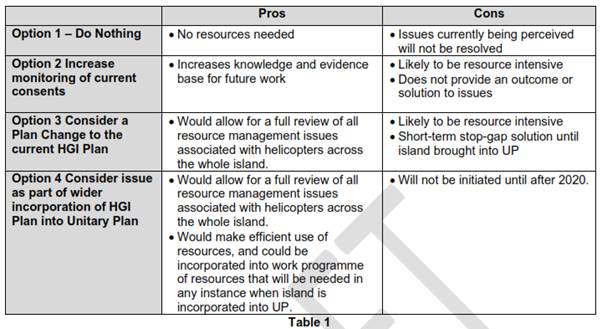
Plans and Places recommended option 4, stating:

So, in 2017, the excuse was already that a change to the district plan was just around the corner, so we should wait for that. Bear that in mind, if Plans and Places give you the same advice today.
That advice was eight years ago and the plan has not been changed. Indeed, the plan change process hasn’t even started. The last plan change process took eight years to complete. Just adding the eight years delay in starting to the eight years it’ll likely take for the process and the total is sixteen years. Then add the wait until the plan change process starts. Could it yet be twenty years from the time that council first refused because “any new provisions would not be operative for long”?
2019
The issue was again raised (this time regionally) and the Plans and Places team replied with the following options:


Despite Plans and Places finding that the vast majority of the recent consents they reviewed were on Waiheke Island, not the Isthmus, they still framed the responses primarily around the Auckland Unitary Plan, rather than the Hauraki Gulf Islands District Plan.
Plans and Places noted that it could take one or two years to complete a plan change, that it would be expensive, that there were other more urgent planning issues, and that a plan change would “open a public and political debate on the merits of helicopter flights in Auckland”. Option 2 was proposed as a “much speedier response as compared to a plan change”…Councillors voted as they were advised. But the promised practice note and interpretation guidance was then forgotten about.
Quiet Sky Waiheke later discovered that it had been promised but not delivered and pursued it, through the Waiheke Local Board. Finally the Chief Planning Office announced in an article in Our Auckland that it had been ‘reviewed and refreshed’…despite it never having existed before. Some months after it was published, it was withdrawn for almost a year for review. Then reinstated after we pursued it again through the Local Board. At the time of writing it has disappeared again. We don’t know why, but we observe that actual practice has been inconsistent with the practice note, so maybe it’s an embarrassing reminder.
2021
Despite the lack of action, there has nonetheless been “a public and political debate on the merits of helicopter flights in Auckland”. In response to this becoming a significant public interest issue, the Waiheke Local Board asked in July 2021 (via a Notice of Motion) for “an information report from council staff on options to increase control over the number of helipads being consented”.
It’s worth noting that had a plan change been commenced at the second time of asking, in 2019, it could have been completed before this third time of asking.
Plans and Places (and the Resource Consent Team) replied (four and a half months later) with a memorandum stating that:
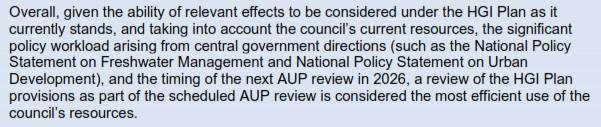
Same excuse – a plan change is just around the corner, so it’s not an efficient use of our resources.
The memorandum further stated:
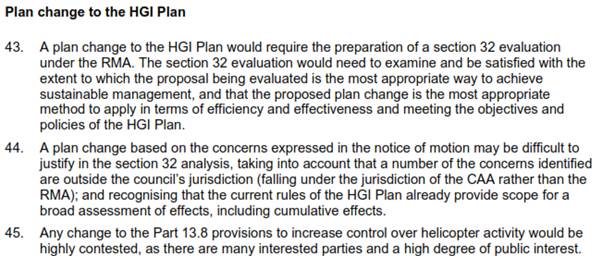

(Note the mention of fears of legal challenge from ‘many interested parties’. There’s more about that below).
Plans and Places again suggested it would (only) consider rule changes when the ACDP:HGI was amalgamated into the AUP…but where the timeframe was previously cited (in its first letter to the Local Board) as ‘after 2020’, it was cited here as being due in 2023 but delayed by Covid until 2024. Yet, in order to be more “efficient”, the advice was to not review it, until 2026:
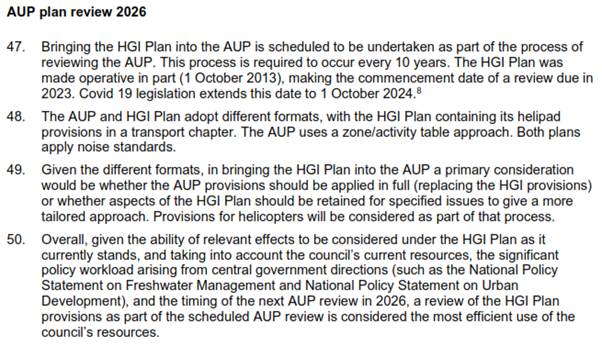
And 2026 (yeah right) would only be the start date of the process. It would take one to two years for a targeted plan change, according to Plans and Places. But it would take a lot longer for a complete plan revision (it took eight years last time). So that would be probably six or seven years longer, on top of the wait for it to begin.
The Waiheke Local Board responded to council’s memorandum – immediately – with the following resolution to:
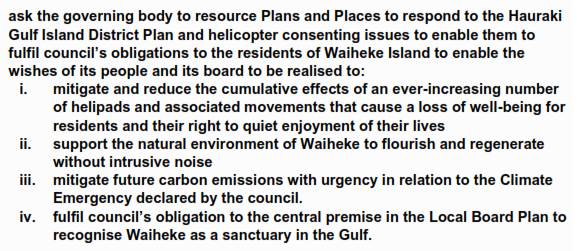
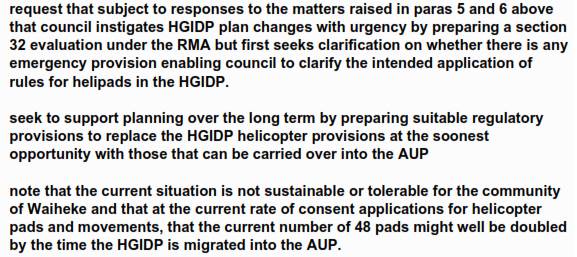
There were presentations from the Waitemata, Waiheke and Aotea Great Barrier Local Boards to the next governing board committee meeting, all requesting relief from the intolerable situation. At 48 helipads, the number had more than doubled since the first time of asking, in 2017. And they are indeed on track for the number to double again before any action is taken, if Plans and Places’ repeated advice to delay until a wider plan change continues to be followed.
In response, council initiated yet another review, again taking ages, and finally reported back with a planning report “Helicopter Activity – Compliance and Monitory: findings and options”, File no. CP2023/01723. The findings were presented to councillors as if the data showed that there wasn’t a problem with helicopters. But re-analysis of the raw data by Quiet Sky Waiheke found:
- It excluded at least one non-complying helipad and illegal landings.
- Despite hours of work, the compliance team only got data for 22 out of the then 62 helipads, and learned that many consent conditions are ‘unenforceable’.
- Five of the 22 helipads exceeded the number of flights set as a limit trigger in CAA Part 157 rules, so they should have applied to the CAA for permission to operate as heliports. Two of them by a huge margin. But they haven’t applied for this.
- In January, there were more helicopter flights to Waiheke than there were to the rest of Auckland combined and still more that flew over Waiheke.
- On a per-capita basis, there were eighty-five times as many complaints from Waiheke, as there were from the rest of Auckland.
- There was a 38% increase in helicopter activity over the study period.
Predictably, the recommendation was to do nothing wait for a wider plan review.
2024
So, Mike Lee brought a Notice of Motion, asking councillors to vote to alter the activity status of helipads to be prohibited in residential areas and to be non-complying in rural areas of Waiheke and Great Barrier. This was opposed by Plans and Places – citing the same cost/wait reasons and that it would be legally difficult. And a ‘compromise’ option of giving effect to the New Zealand Coastal Policy statement (something that had been a longstanding requirement anyway – since 2010, in fact) was voted for instead, as a way to do something in the interim.
Plans and Places, after a long delay, has issued the proposed plan change…and it actually goes out of its way to not change anything, even saying that the “proposed amendments aim only to clarify the existing regulatory framework…[and] will have no impact on future applications for helipads”. And “The proposed plan modification does not introduce or expand matters of consideration or change any standards. The plan modification does not propose a policy shift”.
We’ve received advice that the approach is “crap” and would get “laughed out” of the Environment Court because the NZCPS has to be given effect to now that there is a plan change (nominally to give effect to the NZCPS, no less) and that will require a change to the objectives, policies, activity status and rules. And the Environment Court is where it will be heading if it isn’t changed in response to feedback, through the hearing, to actually give effect to the NZCPS.
A change in activity status is coming…we suggest front-footing the changes, to avoid judicial embarrassment from the Plan Change 16 process.
Misrepresentation of Process
The history goes back to when the current district plan was consulted on and the rules were decided.
The suggested rules for the current plan, as written after the hearing, were that helipads should be a non-complying activity in residential areas. And a discretionary activity in rural areas, with a maximum limit of three inward and outward flights in a seven day period, with additional consideration of noise, visual and amenity effects, impacts on noise sensitive activities, hours of operation, and others. And those effects would be considered within the context of the objective of “protecting the character and amenity values of the islands” and with policies of “not providing for helipads in locations that can adversely affect the amenity of surrounding residents” and with a stated strategy that the Plan “restricts helipads in areas that are easily accessible by more conventional means of transport, and where there is the potential to adversely affect amenity values”. There was also a maximum noise limit set of 85dBA Lmax.
Those are the provisions which came from the district plan change process last time. They would have prevented the proliferation of helipads, as was their stated intention. The hearings panel also commented that “The panel considers that reliance on the Standard [NZS 6807] would be extremely difficult to monitor and enforce”, so recommended against using it.
And then the helicopter companies and a couple of landowners appealed the provisions. Council agreed to more permissive rules for helipads – the ones we have now – and never re-consulted the community on the new rules.
When you read statements from Plans and Places that the existing district plan rules went through the plan development process (it says exactly that in the section 32 report of Plan Change 16) know that they did not. The rules developed in that proper plan development process were replaced by a new set of permissive rules agreed out of court between council and the helicopter companies.
When you read that the existing rules came from a court decision (also stated in the section 32 report of Plan Change 16) know that this is also incorrect. Council settled, out of court, with the appellants and brought the agreed new rules to the court to rubber stamp without passing any judgement (i.e. by consent order).
So, there was effectively no community input and no justice system input to the rules that were eventually agreed between council and their legal opponents – who of course were the very people most interested in permissive rules for helipad consenting. It was the worst possible process for the residents of Waiheke. It was not a balancing of interests (the rules that were finalised by the hearing panel were the ones which balanced interests, until they were supplanted).
Moreover, whatever happened in that out-of-court process has left Plans and Places apprehensive of reengaging with the appellants and they have stated repeatedly ever since how expensive and difficult it would be to change the rules. This fear, or whatever it is, appears to have led Plans and Places to carefully curate the advice they have provided to councillors, to present a picture of the status quo as being proper and adequate and inconsequential and of changes as being challenging and expensive and best delayed. We offer this history, as a corrective, to assist your decision making.
 Quiet Sky Waiheke